


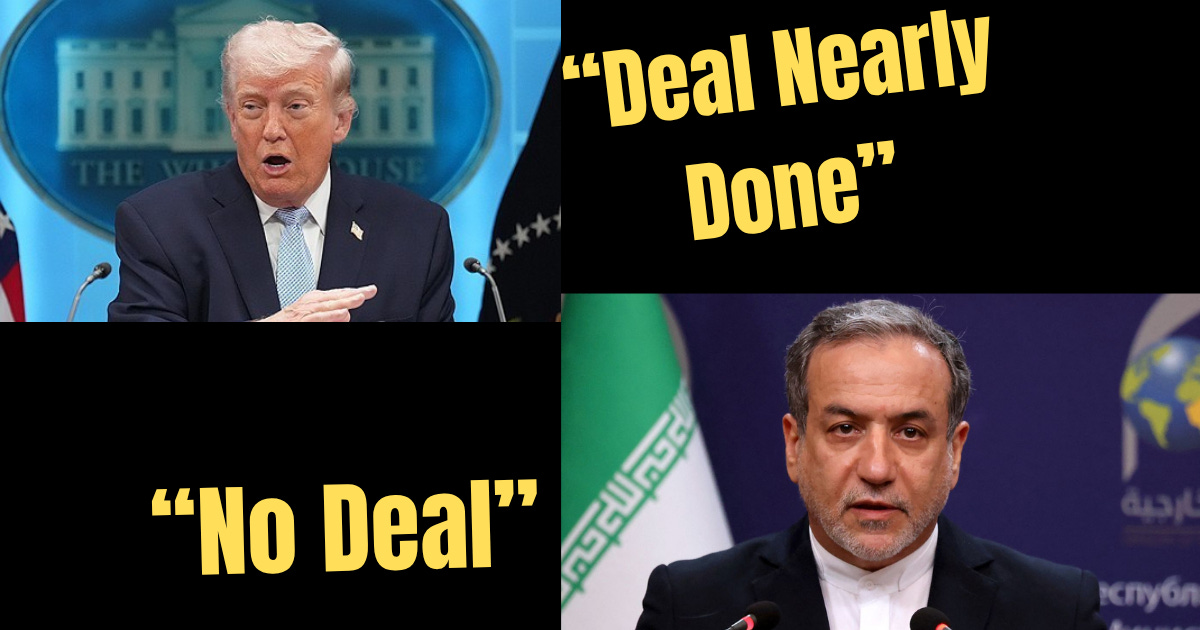
Today’s headlines tell you a lot less about a deal—and a lot more about how Trump manufactures absurdist narratives in real time.
This morning, the village idiot came out and declared victory. He said Iran had agreed to “nearly all” of the U.S. demands—ending its nuclear program, giving up enriched uranium, cooperating with U.S. oversight, even helping stabilize shipping lanes. The way it was framed, you’d think the ink was drying and the press conference was already being scheduled. Of course, by this point, you should know better.
Hours later, reality showed up.
Iranian officials came out and said no such agreement exists. Not partially, not mostly, not a “framework in progress.”
Their position: Trump lied.
So what are we actually looking at here? A he said, they said situation? Both sides finessing a semi-believable, propagandized set of facts?
No. This is a pattern. This is a Trump thing. There’s no both-sidesing this issue. The Iranians don’t have to make things up because Trump consistently beats them to it.
We’ve now seen multiple instances over the past few weeks where Trump publicly claims progress—talks are happening, Iran is “begging” for a deal, major concessions are on the table—only for Iran to come out and deny that anything of substance has been agreed to, or even discussed in the way he describes.
It’s not a misunderstanding or miscommunication. It’s the Art of the Deal. It’s the harebrained strategy of a fully corrupted lunatic.
Trump communicates negotiation through projection. He doesn’t just describe reality—he pretends to create it. If you say a deal is close enough times, loudly enough, you shape markets, influence public perception, and try to box the other side into your version of events.
Although it never works, it does have real-world implications. Markets moved today on the assumption that tensions were easing. Oil reacted. Investors reacted. All based on another ridiculous claim that, by evening, didn’t hold up.
Of course, Iran is doing its own version of messaging—but in the opposite direction. While they have every incentive to downplay negotiations publicly, they don’t have to lie. All they have to do is tell the truth. Trump’s claims are so transparent, so juvenile, that Iran doesn’t need to get particularly creative. They simply refute the claim and offer a more credible version of events. In that dynamic, they win the day—and the argument—by looking like the more sane, reasonable, believable party.
Seems like Iran should write a book entitled, "The Real Art of the Deal".